Friday, 9 August 2013

Scene Analysis: Encounter with The Black Rider

The Black Rider - as depicted by artist, John Howe.
Peter Jackson's trilogy has a never-ending list of brilliant scenes - nearly all are memorable and exceptionally made. However there are a few that are truly outstanding. So many talk about the Battle of Pelennor Fields, attack of the Warg riders, the Balrog scene... but I find that the most overlooked scenes in the entire trilogy are the ones including Ringwraiths in The Fellowship of the Ring. Forget your horror films, the first time you see the Black Riders pursuing Frodo, Sam, Merry, and Pippin on their way to Bree/Rivendell are truly terrifying. Full of suspense, terror, and fear, Jackson does complete justice to Tolkien's creation AGAIN. For this post I will be analysing our first encounter with the Black Rider. Yes we see snippets of the Wraiths thundering out of Minas Morgul & questioning Shire folk about 'Baggins,' but we don't actually encounter them or begin to have any idea of the danger they pose until our four hobbits hide from one under a large tree. I will not only look at how suspense is created but also what the scene means and how it helps the narrative to progress. You can find the clip from the film below:


So, let's begin. After Sam and Frodo literally bump into Merry and Pippin and fall down a hillside onto a main road, Frodo remembers Gandalf's warning to stay off them. This is then followed by Frodo getting a spooky and ominous feeling from the road ahead, and he commands his friends to get off the road - quick!


As all four hobbits jump down under some very large tree roots, Frodo sits and waits anxiously whilst the other three compare vegetables and giggle (they haven't noticed their friend's anxiousness). 


As if out of thin air (this could be a production error but I'm going to assume it was intended), a black horse mounted by a black rider appears from the left side of the tree and stands directly above our hobbits. The gentle tweeting of birds fades into silence as the hooves of the ominous-looking horse and it's master come into view. 


Sam, Merry, & Pippin stop joking around once the hooves alert them to the presence of the other, and they sit silently and as nervously as Frodo. 


The camera pans upwards - showing how the rider is shrouded in black materials, hooded, and without a face. By panning upwards and having the camera at that angle, you see that the hobbits are dwarfed in size but also it would seem, in strength and power. They look helpless and at the mercy of this person. Will it see them?


The camera cuts to a shot of Frodo as he looks back between the gaps in the roots, trying to catch a glimpse of this strange and scary presence that has appeared from nowhere. 


We cut to the hooves of the horse. Black fur with nails in its hooves, this horse is no country breed, but from another, more sinister place. 


We are shown the horses face - the mouth looks wet and ravaged (weather?) hinting that again it has travelled from far away lands. It's black reins with leather straps and metal buckles are a stark contrast from the wood and warm browns we saw in the Shire. A red eye gleams from under its harness. This is no ordinary horse. But what about its rider?


At this moment we are shown the faces of Sam and Merry - both don't look as nervous or as aware as Frodo, but they are curious, and whatever it is up there, they know that it is best they keep quiet.


Finally, with a loud clunk, the rider dismounts its beast. Like the harness of the horse, the rider has shoes made from metal and designed with sharp, angled lines - giving off a harsh and lethal appearance. The black robes come down as far as the floor. 


Frodo's head turns sharply away and faces the front again. He has seen that this thing is not local, but from a dark place. It is also clear that this thing has been drawn to the same spot as the hobbits for a reason. What is he looking for?


The rider is looking for them. In a terrifying moment the rider bends down, hands firmly clutching the roots above the heads of the hobbits - inches away from their discovery. For definite we see that this creature has no face - beneath its hood is dense shadow. Every movement the rider makes sounds a large clunk and clink of metal - a hard, industrial sound.


To emphasise just how close to danger the hobbits are from the rider, the camera shows us a close-up of the rider's hand which is large and covered in a metal glove with sharp edges and spikes. Just below that deadly looking hand is Frodo, looking up in fear.


The rider obviously can't see them, so he tries something else... he tries to sniff them out. Taking in a few big whiffs he tries to catch their scent - or at least the scent of something. 


By now the hobbits know that they are whom the rider is after. Even though they can't see him (save Frodo) the rider has an aura of doom and fear which they can feel. The longer the rider is there, the more that nature recoils from it. Even the creepiest of crawlies flee from its presence. A large spider is shown crawling across Merry's shoulder and away from the position of the unwelcome stranger. More insects follow, including centipedes and worms. Sam, Merry, & Pippin all notice nature's reaction to the presence of this unknown but terrifying presence. 


The longer the rider lingers, the more its presence is felt. Nature is fleeing but now it seems that something is responding to the rider. Frodo goes into a sort of hypnosis/trance and before he knows it, he has taken the ring out of his pocket and is about to put it on his finger. The one thing Gandalf told him never to do! Has Frodo lost his mind? Is he doing this consciously? Or is he being taken over by some other force?


As soon as the Ring is out of Frodo's pocket - in the open air - we cut to the rider. His head jerks to the left (the direction of the Ring); he senses it. Even the horse has grown agitated. Are they connected to the Ring? Do they feel its presence?


Unusual, trance-like sounds like throbs and wobs and shrills can be heard over the scene - this is the sound of the Ring (I will speak of this in more detail in another post). The Ring is awake and aware that it is close to being found if only it can make the Ringbearer put it on and alert the rider to its location. Frodo puts the Ring closer to his finger, but luckily Sam intervenes. Nudging Frodo (maybe he thinks he feels faint?) he actually awakens our Ringbearer out of the trance.


As soon as Frodo is aware of what he is doing, he snatches the Ring away which throws off the scent of the rider (his head jerks away frustratedly). 


The hobbits can't wait under that tree forever and the wait has already gone on for long enough. Using his instinct (and the idea that for some reason this rider is after one of them), Merry throws a bag of vegetables away from the tree. This distracts the rider and drives it away (along with the shrieking sounds of the creature on top of it) from the tree as it looks for where the sound could have come from. He gives up and is gone.


Within seconds of the rider fleeing the scene, our hobbits do their own fleeing as they run down to the bottom of the hill to get away from that dreadful spot. Looking terrified and understanding that they just had a narrow escape, Merry asks a very good question: what was that?


Frodo does not respond. He is too in shock as to what just happened to him under the tree. Gandalf's words concerning the power of the Ring and how it wants to be found start to ring true. Frodo would never have even thought of putting the Ring on when that rider arrived, so why did he do it? 


Looking confused but also terrified as the reality of the Ring dawns on him, Frodo looks down at his hand (the camera pans down with it) and opens it to reveal the harmless looking golden band which almost cost him life seconds ago. 


Why is this scene so pivotal in the film? Firstly, it shows us the servants of Mordor for the first time. They look completely different to the soft, happy, and friendliness of the Shire, and instead have a dark, sinister, harsh, and merciless appearance. Instead of wood and cotton, you have black shrouds and metal. Furthermore it shows us that indeed Frodo and the Ring are being hunted. We also witness for the first time the incredible danger the Ring poses - Sauron's spirit, cruelty, and power live within it. It wants to reunite with its master and when the Wraiths are near/calling out to it, it responds back. 

Gandalf explained this in Bag End but Frodo took it as a simple warning to live by rather than understanding the serious danger he is in. He couldn't fully believe it until he experienced it, but now he has. The Ring is his enemy and what is most terrifying and dangerous is that even if Frodo does all he can to conceal himself and avoid danger, the Ring can control our Ringbearer and push him straight into the path of evil.

This scene is so superbly set-up and directed. You really feel the terror of the hobbits as this unknown with a dooming presence appears, and their fear as they realise it is hunting for someone/something. As I said earlier, this scene gives most horrors a run for their money. It is overlooked as pivotal because it isn't action-packed and has almost no dialogue - but that is where it's brilliance lies! The tension and suspense are built purely from shots of what is actually going on, the little that Frodo can see, and the facial expressions of the hobbits as their anxiety increases and the Black Rider's senses are alerted. 

Best of all it introduces us to the evil nature of the Ring - Gandalf's warnings do not do the danger of the quest justice. The Ring is being hunted by servants of Sauron and it will do all it can, including controlling Frodo in the moments where he needs to be completely on his guard, in order to get back to its master, Sauron. 

Wednesday, 31 July 2013

Gandalf the Grey: Words of wisdom

Since The Lord of the Rings trilogy has been available on VHS/DVD, I have watched it every year without fail (this isn't me trying to sound like a major fan - I know that this is a small number viewings compared to others). However, it was only during my most recent viewing in January 2013 that I came to notice the importance in some of Gandalf the Grey's earliest conversations with Frodo in The Fellowship of the Ring. Not only does Gandalf give Frodo some incredibly wise, universal truths, but he also manages to almost foretell what Frodo will encounter on his quest and therefore advises him with words that prove immeasurable in their significance. Advice and warnings - Gandalf gives Frodo both even though he cannot see the future, but by trusting how he feels and listening to the wisdom he possesses. Sure enough Gandalf's words prove true and Frodo and the fate of Middle Earth are the better for it; Gandalf knew what he was talking about and it is he who is responsible for guiding Frodo correctly.

After this most recent viewing I embarked on finally reading Tolkien's books (having endeavoured when I was 11 and finding it a little too difficult). Happily I could see that Peter Jackson, Fran Walsh, and Philippa Boyens had included much of Tolkien's words directly from the book in the film script, or sometimes with only several words changed. So to highlight my observations I will use the quotes from the book and compare them to where or how they were used in the film.

Firstly, let's focus on Gandalf's pearls of wisdom/warnings in Fellowship. Both occur in the chapter, 'The Shadow of the Past', where Gandalf reveals to Frodo the history of Sauron, the possible doom ahead, and everything to do with the Ring that Bilbo has left him. Here is our first quote:
'I wish it need not have happened in my time,' said Frodo.  
'So do I,' said Gandalf, 'and so do all who live to see such times. But that is not for them to decide. All we have to decide is what to do with the time that is given us.'
These words are so beautifully put together. Throughout the books Tolkien shows us the natural flare/creative brilliance he had for writing but also the supreme level of skill he had accumulated through his studies and time as a professor. The sentence flows wonderfully, and each clause helps us to stop and think. The best bit about this phrase is that it can be applied to almost any crisis we encounter in life.


The importance of these words is that Gandalf is calming this frightened little hobbit down by putting things in perspective. He tells him not to look at everything at its daunting worst and not despair, but simply to act accordingly and to do what you believe to be best. These lines prove to be very fitting when Frodo, towards the end of Fellowship finally understands the great danger of the quest and what an evil force the Ring is. With the help of Galadriel and Boromir, he sees what will become of the Shire and his friends if Sauron were to possess the Ring again, and with the help of Gandalf's words, Frodo realises that the only way to destroy the Ring is to go alone and break away from Aragorn and the others. Here are Frodo's words which he speaks aloud to himself as he stands alone in Amon Hen (in the chapter, 'The Breaking of the Fellowship'):
Frodo rose to his feet. A great weariness was on him, but his will was firm and his heart lighter. He spoke aloud to himself. 'I will do now what I must,' he said. 'This at least is my plan: the evil of the Ring is already at work even in the Company, and the Ring must leave them before it does more harm. I will go alone. Some I cannot trust, and those I can trust are too dear to me: poor old Sam, and Merry and Pippin. Strider, too; his heart yearns for Minas Tirith, and he will be needed there, now Boromir has fallen into evil. I will go alone. At once.'
The use of weariness juxtaposed by firm will and lighter heart show that Gandalf was right - regardless of the burden Frodo has around his neck, he is willing to destroy it with all the strength he has left, whilst knowing what has to be done has eased his worries, for there is no other choice for him to take if he wants the Ring to be gone.

Our next quote concerns Gollum and is again from 'The Shadow of the Past' in Fellowship. By telling the history of the Ring, Gandalf naturally has to tell Frodo about Bilbo's predecessor Ringbearer, Gollum, and his fall. After hearing of the devious deeds Gollum has performed in his life and of his betraying the name 'Baggins' to Sauron's servants, Frodo sees Gollum as a traitor, a creep, and his enemy. When Gandalf divulges that Bilbo had Gollum at the mercy of his sword but chose to not kill him, Frodo is angered that Bilbo had the chance to prevent the creature from betraying them:
'What a pity that Bilbo did not stab that vile creature, when he had a chance!'
'Pity? It was Pity that stayed his hand. Pity, and Mercy: not to strike without need. And he has been well rewarded, Frodo. Be sure that he took so little hurt from the evil, and escaped in the end, because he began his ownership of the Ring so. With Pity.'
'I am sorry,' said Frodo. 'But I am frightened; and I do not feel any pity for Gollum.'
'You have not seen him,' Gandalf broke in. 
'No, and I don't want to,' said Frodo. 'I can't understand you. Do you mean to say that you, and the Elves, have let him live on after all those horrible deeds? Now at any rate he is as bad as an Orc, and just an enemy. He deserves death.' 
'Deserves it! I daresay he does. Many that live deserve death. And some that die deserve life. Can you give it to them? Then do not be too eager to deal out death in judgment. For even the very wise cannot see all ends. I have not much hope that Gollum can be cured before he dies, but there is a chance of it. And he is bound up with the fate of the Ring. My heart tells me that he has some part to play yet, for good or ill, before the end; and when that comes, the pity of Bilbo may rule the fate of many - yours not least. In any case we did not kill him: he is very old and very wretched. The Wood-elves have him in prison, but they treat him with such kindness as they can find in their wise hearts.'

What Gandalf tells Frodo here can be called a universal truth - it can be applied to life in general, who are we to decide who dies and who lives? He warns Frodo that Bilbo's mercy was not ill-judged because on moral terms he was right but also once Frodo sees Gollum, he may understand and even sympathise with the creature. A little later in 'The Taming of Smeagol' chapter in The Two Towers, Frodo finally meets Gollum, and he remembers Gandalf's warning. After being attacked by the wretched creature and Sam ready to kill him, Frodo finds that he cannot do what he said he would:
It seemed to Frodo then that he heard, quite plainly but far off, voices out of the past: [...] 'And yet, as you see, I will not touch the creature. For now that I see him, I do pity him.'
Sam stared at his master, who seemed to be speaking to someone who was not there.
It's as if Frodo is speaking to his memory of Gandalf during their conversation in 'The Shadow of the Past'. He remembers his words and finds himself eating his own. The discussion about Gollum proves to be of profound importance to the fate of the Ring for Gandalf also predicts that Gollum should not be harmed because he, a Ringbearer, is sure to have some part to play in the upcoming events. Whether it aids the quest or not. If Frodo had not listened to Gandalf, then the results would have been catastrophic. Without Gollum Frodo & Sam would have been lambs to the slaughter by entering Mordor via The Black Gate. Gollum provides with safe passage into Mordor. Although it is still a deadly passage as it includes the Dead Marshes, the Morgul Vale, and Shelob's lair, it is a great deal safer than the Black Gate, because you have a chance to pass through it unnoticed. Additionally, when Frodo finally reaches the crack of doom he succumbs to the evil force of Ring and refuses to destroy it. Thankfully Gollum is around, and he bites Frodo's finger off, taking the ring for himself. During his joy of catching the Ring, he falls back into the firey chasm of Orodruin and is therefore THE destroyer of the Ring. Frodo failed at the last hurdle, and it was up to Gollum, as fate would have it, to finish the job (even if it was accidental).

Regardless of Gollum saving the quest, Sam is too consumed with hate of the creature, particularly when he sees how he massacred his master's hand. But Frodo is aware of his inability to finish the quest, and Gandalf's words come back to haunt him:
'Your poor hand!' he said. 'And I have nothing to bind it with, or comfort it. I would have spared him a whole hand of mine rather. But he's gone now beyond recall, gone for ever.' 
'Yes,' said Frodo. 'But do you remember Gandalf's words: Even Gollum may have something yet to do? But for him, Sam, I could not have destroyed the Ring. The Quest would have been in vain, even at the bitter end. So let us forgive him! For the Quest is achieved, and now all is over. I am glad you are here with me. Here at the end of all things, Sam.'
Very bravely, Frodo knows that Gollum saved it all in the end and forgives him. Frodo didn't fail the task - he was not weak at all - but the Ring was too strong at the very end. In fact, one wonders if the greatest power of the Ring is the fact that even at the very end, nobody is able to destroy it. Luckily, through Gollum's greed and corrupted nature (because of the Ring), his trying to stop the destruction of his precious resulted in him achieving the opposite.

Throughout the story Gandalf's wisdom and advice proves immeasurable in its importance to the quest succeeding. He teaches Frodo well. Everybody had a part to play, and the quest would not have been achieved without Gandalf's help, Sam's assistance and bravery, Frodo's resilience and strength, nor Gollum's devotion to his precious. Every character in LOTR contributed something, big or small, that enabled the achievement of the quest and the defeat of Sauron.


I really adore how Peter Jackson uses Gandalf's phrases in the films. The setting isn't in Bag End before the quest begins but still where Jackson puts them makes them even more important, powerful, and most importantly when concerning film - cinematic. Whilst Gandalf waits to remember which path to take in the Mines of Moria, Frodo notices Gollum following them, therefore starting up a conversation about the creature. It is here that Gandalf furrows his brow at Frodo and warns him of the moral nature of killing and of his feeling that Gollum has a part to play in the quest. He understands that Frodo is naiive and therefore teaches him with words which resound loudly with Frodo later on. To this Frodo reacts with the despairing comment of wishing the Ring had never come to him. Gandalf then replies with his now famous phrase. What's beautiful about this scene is that both characters are in the dark, waiting, and it is the last time before Gandalf's "death" that he has one last talk with Frodo alone. It turns out that this last talk will serve Frodo the best, for soon Frodo will have no guidance bar his own heart and what he has learnt from the wise. Here is the scene:


What Jackson manages to do so brilliantly with this scene is he brings it up at the end of Fellowship when Frodo is stood on the banks of Amon Hen, plucking up the courage to set out on the quest alone. We hear Frodo thinking 'I wish the Ring had never come to me,' with tears in his eyes, but his face changes as he begins to hear the warm, gravelly voice of Gandalf, and those wise words he spoke to him back in Moria:


As the words are spoken, the camera fades to a clip of Gandalf as Frodo would have seen him in Moria, speaking TO him. Those calm words give Frodo the push to do what he knows must be done, what is right. As the clips fades back to Frodo we see more tears running down his cheeks. The memory of Gandalf is strong and sad - and he listens to him. The look in his eyes is different now though, there is a determined stare in them.

What makes this scene so powerful - and arguably one of the most powerful in the trilogy - is the universal truth that Gandalf speaks of. The words can be applied to any crisis, in any era, in any country. It doesn't matter that Middle Earth doesn't exist in real life, or that Orcs and Nazgul are fantasy creatures - the themes of the story are real and we ought to listen to them as readers.

The performances add to power of the scenes massively. Sir Ian McKellen with his kind eyes and beautiful voice carry those words in Moria and at Amon Hen with gravitas so that they are thought-provoking, profound, yet wonderfully calming. Elijah Wood has one of those rare qualities where an actor can speak solely with his eyes. The sadness, despair, and loneliness in his glistening, tearful eyes as he thinks of the doom that lies ahead transform into determination after he remembers what Gandalf told him. The addition of Howard Shore's piece, 'The Breaking of the Fellowship' being played in the background adds to the emotion of the scene, and gives it a sound of destiny, fate, and human strength - mirroring what Frodo has on his shoulders. It is actually one of my favourite pieces from the motion picture soundtrack.

Apologies for this rambly post. I tried to explain as best I can. But in all honesty by just reading Tolkien's quotes from the book and watching the clips from the films - you don't need any analysis or explanations. They are either so well written, constructed, or performed, that they speak volumes anyway; transcending the realms of literature and film by connecting directly with the human soul.

Tuesday, 18 June 2013

LOTR Books: Recent purchases

I recently bought four books concerning Peter Jackson's The Lord of the Rings trilogy. After receiving The Hobbit: Official Movie Guide for my birthday back in January, I realised that even though I am fascinated by the LOTR trilogy, I have no books on it. The Hobbit movie guide gave so much behind the scenes information, interviews, etc, (I definitely recommend this one) that it made me hungry for more information on LOTR. To feed that hunger, I went ahead and bought four very impressive books:


The Art of The Lord of the Rings: The Fellowship of the Ring by Gary Russell.
The Art of The Lord of the Rings: The Two Towers by Gary Russell.
The Art of The Lord of the Rings: The Return of the King by Gary Russell.
The Music of the Lord of the Rings Films by Doug Adams.

One aspect of the trilogy which I adore is the locations, sets, and general artwork; so much work and so many artists worked on this project and here is a book giving you as much information as possible about some of the artists and their contributions. At the forefront of the teams are of course John Howe and Alan Lee - both world-renowned for their artwork concerning Tolkien's work, and when Jackson embarked on adapting the books, he asked Howe and Lee for their services because he admired their work so greatly. Beautifully pieced together and written by Gary Russell (the time and effort to compose these three books is astounding) you have the creative world behind LOTR at your fingertips, each so stunningly presented that the books are works of art themselves.

I highly recommend these books for any fan of the films and the books. Adapting books - especially LOTR which has so much detail, so many different landscapes, races, etc - takes so much hard work. Even if you have an amazing idea, if it doesn't work then you have to make alterations or start from scratch. There are some fascinating parts in this book that describe the process of making certain sets/costumes/creatures, for example, the Balrog in Moria. You are shown different sketches of how it may have looked, but also they show photographs of the model of a Balrog's head in different lighting so that they could get an idea of how it would look fearsome/dark/deadly.

Below you will find some stills of each of the books. My favourite locations are Lothlorien, Moria, The Great River, The Dead Marshes, and Minas Morgul, so it was really fascinating seeing Lee, Howe, or another artists original drawings, how they changed them, and then how they finally appeared in film. There are a lot of green-screen shots too where we see the actors looking at nothing but a field, but then after the artists and special effects team have worked on it, suddenly the actors are looking at a deep valley full of wildlife and forests. The composition of a Rivendell miniature into a mountainside which is also composed from images of different mountainsides, waterfalls, etc, was particularly fascinating.

All three from 'The Art of...' collection by Gary Russell.
Beautiful front cover showing Argonath on The Great River from Fellowship.

Lothlorien is one of the most visually stunning locations in film history - wouldn't mind living there!

The tower of Orthanc and Barad Dur dominate the front cover for Two Towers.

So much effort went into the lighting of Fangorn in order to create the right mood; should they go for greens/browns/ blues?

The location we were all anticipating the most... Mordor; The Eye of Sauron roars with fire, surrounded by ferocious clouds.

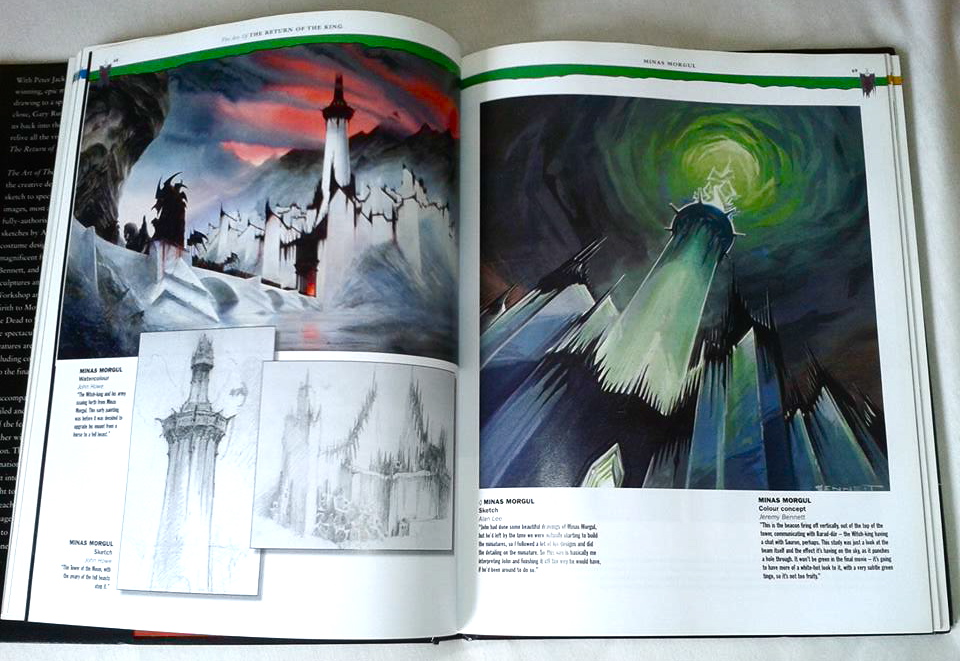
Minas Morgul; Howe's artwork for this is truly outstanding. How can you make a drawing look evil and menacing?

Another book I bought recently was The Music of The Lord of the Rings written by Doug Adams. I haven't read it yet like my other books but I cannot wait to. This is the most detailed, informative piece of work compiled about a film soundtrack - but that's pretty fitting seeing as the size and depth of LOTR soundtrack is enormous and greater than anything in cinema before. Howard Shore's score for the films has been praised critically and commercially, but there are so many reasons why his score is so acclaimed and loved. It transcends the realms of cinema music by lightyears, and it is wonderful that all of his hard work has now been put together in this beautiful book. I've had a quick flick through and not only is the music discussed in detail, but each track is broken down and dissected - it is a dream book for anybody who loves the LOTR soundtrack as much as myself. I can't wait to really get stuck into this book and listen to each track whilst studying its analysis. Here are some photographs:


The book even comes with an exclusive extra recordings disc. 

Snippets from Shore's music notes features his annotations, etc. Amazing!


I love The Lord of the Rings, and these four books - although pricey - were worth every penny. They tell me everything I could possibly know or want to know about Jackson and his teams masterpiece. Never before has so much information and behind the scenes secrets been kept, recorded, and produced for a film than for LOTR, and being a project of such enormity and depth, there is tonnes of information for you to get lost in and wonder at. I'll cherish them always and keep them on my bookshelf proudly for the rest of my life. Thanks Gary Russell and Doug Adams!