Showing posts with label tolkien. Show all posts

Wednesday, 31 July 2013

Gandalf the Grey: Words of wisdom

Since The Lord of the Rings trilogy has been available on VHS/DVD, I have watched it every year without fail (this isn't me trying to sound like a major fan - I know that this is a small number viewings compared to others). However, it was only during my most recent viewing in January 2013 that I came to notice the importance in some of Gandalf the Grey's earliest conversations with Frodo in The Fellowship of the Ring. Not only does Gandalf give Frodo some incredibly wise, universal truths, but he also manages to almost foretell what Frodo will encounter on his quest and therefore advises him with words that prove immeasurable in their significance. Advice and warnings - Gandalf gives Frodo both even though he cannot see the future, but by trusting how he feels and listening to the wisdom he possesses. Sure enough Gandalf's words prove true and Frodo and the fate of Middle Earth are the better for it; Gandalf knew what he was talking about and it is he who is responsible for guiding Frodo correctly.

After this most recent viewing I embarked on finally reading Tolkien's books (having endeavoured when I was 11 and finding it a little too difficult). Happily I could see that Peter Jackson, Fran Walsh, and Philippa Boyens had included much of Tolkien's words directly from the book in the film script, or sometimes with only several words changed. So to highlight my observations I will use the quotes from the book and compare them to where or how they were used in the film.

Firstly, let's focus on Gandalf's pearls of wisdom/warnings in Fellowship. Both occur in the chapter, 'The Shadow of the Past', where Gandalf reveals to Frodo the history of Sauron, the possible doom ahead, and everything to do with the Ring that Bilbo has left him. Here is our first quote:
'I wish it need not have happened in my time,' said Frodo.  
'So do I,' said Gandalf, 'and so do all who live to see such times. But that is not for them to decide. All we have to decide is what to do with the time that is given us.'
These words are so beautifully put together. Throughout the books Tolkien shows us the natural flare/creative brilliance he had for writing but also the supreme level of skill he had accumulated through his studies and time as a professor. The sentence flows wonderfully, and each clause helps us to stop and think. The best bit about this phrase is that it can be applied to almost any crisis we encounter in life.


The importance of these words is that Gandalf is calming this frightened little hobbit down by putting things in perspective. He tells him not to look at everything at its daunting worst and not despair, but simply to act accordingly and to do what you believe to be best. These lines prove to be very fitting when Frodo, towards the end of Fellowship finally understands the great danger of the quest and what an evil force the Ring is. With the help of Galadriel and Boromir, he sees what will become of the Shire and his friends if Sauron were to possess the Ring again, and with the help of Gandalf's words, Frodo realises that the only way to destroy the Ring is to go alone and break away from Aragorn and the others. Here are Frodo's words which he speaks aloud to himself as he stands alone in Amon Hen (in the chapter, 'The Breaking of the Fellowship'):
Frodo rose to his feet. A great weariness was on him, but his will was firm and his heart lighter. He spoke aloud to himself. 'I will do now what I must,' he said. 'This at least is my plan: the evil of the Ring is already at work even in the Company, and the Ring must leave them before it does more harm. I will go alone. Some I cannot trust, and those I can trust are too dear to me: poor old Sam, and Merry and Pippin. Strider, too; his heart yearns for Minas Tirith, and he will be needed there, now Boromir has fallen into evil. I will go alone. At once.'
The use of weariness juxtaposed by firm will and lighter heart show that Gandalf was right - regardless of the burden Frodo has around his neck, he is willing to destroy it with all the strength he has left, whilst knowing what has to be done has eased his worries, for there is no other choice for him to take if he wants the Ring to be gone.

Our next quote concerns Gollum and is again from 'The Shadow of the Past' in Fellowship. By telling the history of the Ring, Gandalf naturally has to tell Frodo about Bilbo's predecessor Ringbearer, Gollum, and his fall. After hearing of the devious deeds Gollum has performed in his life and of his betraying the name 'Baggins' to Sauron's servants, Frodo sees Gollum as a traitor, a creep, and his enemy. When Gandalf divulges that Bilbo had Gollum at the mercy of his sword but chose to not kill him, Frodo is angered that Bilbo had the chance to prevent the creature from betraying them:
'What a pity that Bilbo did not stab that vile creature, when he had a chance!'
'Pity? It was Pity that stayed his hand. Pity, and Mercy: not to strike without need. And he has been well rewarded, Frodo. Be sure that he took so little hurt from the evil, and escaped in the end, because he began his ownership of the Ring so. With Pity.'
'I am sorry,' said Frodo. 'But I am frightened; and I do not feel any pity for Gollum.'
'You have not seen him,' Gandalf broke in. 
'No, and I don't want to,' said Frodo. 'I can't understand you. Do you mean to say that you, and the Elves, have let him live on after all those horrible deeds? Now at any rate he is as bad as an Orc, and just an enemy. He deserves death.' 
'Deserves it! I daresay he does. Many that live deserve death. And some that die deserve life. Can you give it to them? Then do not be too eager to deal out death in judgment. For even the very wise cannot see all ends. I have not much hope that Gollum can be cured before he dies, but there is a chance of it. And he is bound up with the fate of the Ring. My heart tells me that he has some part to play yet, for good or ill, before the end; and when that comes, the pity of Bilbo may rule the fate of many - yours not least. In any case we did not kill him: he is very old and very wretched. The Wood-elves have him in prison, but they treat him with such kindness as they can find in their wise hearts.'

What Gandalf tells Frodo here can be called a universal truth - it can be applied to life in general, who are we to decide who dies and who lives? He warns Frodo that Bilbo's mercy was not ill-judged because on moral terms he was right but also once Frodo sees Gollum, he may understand and even sympathise with the creature. A little later in 'The Taming of Smeagol' chapter in The Two Towers, Frodo finally meets Gollum, and he remembers Gandalf's warning. After being attacked by the wretched creature and Sam ready to kill him, Frodo finds that he cannot do what he said he would:
It seemed to Frodo then that he heard, quite plainly but far off, voices out of the past: [...] 'And yet, as you see, I will not touch the creature. For now that I see him, I do pity him.'
Sam stared at his master, who seemed to be speaking to someone who was not there.
It's as if Frodo is speaking to his memory of Gandalf during their conversation in 'The Shadow of the Past'. He remembers his words and finds himself eating his own. The discussion about Gollum proves to be of profound importance to the fate of the Ring for Gandalf also predicts that Gollum should not be harmed because he, a Ringbearer, is sure to have some part to play in the upcoming events. Whether it aids the quest or not. If Frodo had not listened to Gandalf, then the results would have been catastrophic. Without Gollum Frodo & Sam would have been lambs to the slaughter by entering Mordor via The Black Gate. Gollum provides with safe passage into Mordor. Although it is still a deadly passage as it includes the Dead Marshes, the Morgul Vale, and Shelob's lair, it is a great deal safer than the Black Gate, because you have a chance to pass through it unnoticed. Additionally, when Frodo finally reaches the crack of doom he succumbs to the evil force of Ring and refuses to destroy it. Thankfully Gollum is around, and he bites Frodo's finger off, taking the ring for himself. During his joy of catching the Ring, he falls back into the firey chasm of Orodruin and is therefore THE destroyer of the Ring. Frodo failed at the last hurdle, and it was up to Gollum, as fate would have it, to finish the job (even if it was accidental).

Regardless of Gollum saving the quest, Sam is too consumed with hate of the creature, particularly when he sees how he massacred his master's hand. But Frodo is aware of his inability to finish the quest, and Gandalf's words come back to haunt him:
'Your poor hand!' he said. 'And I have nothing to bind it with, or comfort it. I would have spared him a whole hand of mine rather. But he's gone now beyond recall, gone for ever.' 
'Yes,' said Frodo. 'But do you remember Gandalf's words: Even Gollum may have something yet to do? But for him, Sam, I could not have destroyed the Ring. The Quest would have been in vain, even at the bitter end. So let us forgive him! For the Quest is achieved, and now all is over. I am glad you are here with me. Here at the end of all things, Sam.'
Very bravely, Frodo knows that Gollum saved it all in the end and forgives him. Frodo didn't fail the task - he was not weak at all - but the Ring was too strong at the very end. In fact, one wonders if the greatest power of the Ring is the fact that even at the very end, nobody is able to destroy it. Luckily, through Gollum's greed and corrupted nature (because of the Ring), his trying to stop the destruction of his precious resulted in him achieving the opposite.

Throughout the story Gandalf's wisdom and advice proves immeasurable in its importance to the quest succeeding. He teaches Frodo well. Everybody had a part to play, and the quest would not have been achieved without Gandalf's help, Sam's assistance and bravery, Frodo's resilience and strength, nor Gollum's devotion to his precious. Every character in LOTR contributed something, big or small, that enabled the achievement of the quest and the defeat of Sauron.


I really adore how Peter Jackson uses Gandalf's phrases in the films. The setting isn't in Bag End before the quest begins but still where Jackson puts them makes them even more important, powerful, and most importantly when concerning film - cinematic. Whilst Gandalf waits to remember which path to take in the Mines of Moria, Frodo notices Gollum following them, therefore starting up a conversation about the creature. It is here that Gandalf furrows his brow at Frodo and warns him of the moral nature of killing and of his feeling that Gollum has a part to play in the quest. He understands that Frodo is naiive and therefore teaches him with words which resound loudly with Frodo later on. To this Frodo reacts with the despairing comment of wishing the Ring had never come to him. Gandalf then replies with his now famous phrase. What's beautiful about this scene is that both characters are in the dark, waiting, and it is the last time before Gandalf's "death" that he has one last talk with Frodo alone. It turns out that this last talk will serve Frodo the best, for soon Frodo will have no guidance bar his own heart and what he has learnt from the wise. Here is the scene:


What Jackson manages to do so brilliantly with this scene is he brings it up at the end of Fellowship when Frodo is stood on the banks of Amon Hen, plucking up the courage to set out on the quest alone. We hear Frodo thinking 'I wish the Ring had never come to me,' with tears in his eyes, but his face changes as he begins to hear the warm, gravelly voice of Gandalf, and those wise words he spoke to him back in Moria:


As the words are spoken, the camera fades to a clip of Gandalf as Frodo would have seen him in Moria, speaking TO him. Those calm words give Frodo the push to do what he knows must be done, what is right. As the clips fades back to Frodo we see more tears running down his cheeks. The memory of Gandalf is strong and sad - and he listens to him. The look in his eyes is different now though, there is a determined stare in them.

What makes this scene so powerful - and arguably one of the most powerful in the trilogy - is the universal truth that Gandalf speaks of. The words can be applied to any crisis, in any era, in any country. It doesn't matter that Middle Earth doesn't exist in real life, or that Orcs and Nazgul are fantasy creatures - the themes of the story are real and we ought to listen to them as readers.

The performances add to power of the scenes massively. Sir Ian McKellen with his kind eyes and beautiful voice carry those words in Moria and at Amon Hen with gravitas so that they are thought-provoking, profound, yet wonderfully calming. Elijah Wood has one of those rare qualities where an actor can speak solely with his eyes. The sadness, despair, and loneliness in his glistening, tearful eyes as he thinks of the doom that lies ahead transform into determination after he remembers what Gandalf told him. The addition of Howard Shore's piece, 'The Breaking of the Fellowship' being played in the background adds to the emotion of the scene, and gives it a sound of destiny, fate, and human strength - mirroring what Frodo has on his shoulders. It is actually one of my favourite pieces from the motion picture soundtrack.

Apologies for this rambly post. I tried to explain as best I can. But in all honesty by just reading Tolkien's quotes from the book and watching the clips from the films - you don't need any analysis or explanations. They are either so well written, constructed, or performed, that they speak volumes anyway; transcending the realms of literature and film by connecting directly with the human soul.

Monday, 27 May 2013

Scene Analysis: The Return of the King - The Final Scene.

One of the most common debates concerning The Lord of the Rings Trilogy is whether Peter Jackson ended it well. Many have said that the trilogy should have ended with Aragorn's coronation at Minas Tirith, others say it should have ended when Frodo left for The Grey Havens, and some say that it should have ended even earlier with the destruction of the Ring and the collapse of Mordor. It is a difficult question, firstly because you can never please everyone, and secondly, Jackson had the difficult task throughout the books of deciding what was cinematic and what wasn't. What works in books doesn't always translate well on film, and Jackson made a lot of changes in the story to increase the cinematic effect of the films - which I believe is completely justified because any changes made never altered or ruined the overall theme of Tolkien's work.

However, when it comes to how to end this enormous and epic trilogy, do you need a big climactic finale to give it that ultimate punch? Or do you try and stay as true to the book as possible and go for a more emotional ending that causes the film to run a little longer and therefore annoy some of the audience. I finally read JRR Tolkien's books this year and have seen that Jackson cut a lot of the ending out already, e.g. The Scouring of the Shire. I understand his choice for this, the film would have been too long and it wasn't quite essential for the films themselves. In the book it works because when they defeat 'Sharky' Saruman and rebuild the Shire they plant mellyrn trees that Galadriel gifted them from Lothlorien... basically a lot of events that happened earlier in the books are tied up at the end. If they weren't included in the film to start with then there's nothing to really tie-up at the end.

Since the films release over a decade ago I was unsure of whether The Return of the King had dragged on a little too long and whether Jackson had perhaps indulged himself. But after finally reading Tolkien's trilogy and watching the films for the, I don't know, 50th (?) time, I believe that it ended perfectly with Sam returning to his new family and finally moving on. I will be discussing the ending and dissecting it's shots, dialogue, and themes to justify my opinion. You will find the clips for the two scenes that I will be analysing to the side here and later in the blogpost. Clip 1 is The Grey Havens Scene and Clip 2 is The End scene; any times I mention will be from these clips.


Let's start with the scene at The Grey Havens. In the films we have just seen Frodo finishing his book whilst he tells us that he can't live in the Shire anymore, his quest as the Ringbearer has made it impossible for him to continue life in his home at Bag End,
'How do you pick up the threads of an old life? How do you go on... when in your heart you begin to understand... there is no going back? There are some things that time cannot mend... some hurts that go too deep... that have taken hold.'
Here he is referring to the wound he received from the Witch-King at Weathertop wound which still causes him physical pain but also the memories and trauma of his journey to Mordor and his burden of the Ring are what gives him the greatest pain, they are what goes too deep. His wounds are both physical and psychological. He is traumatised for life. When you've endured what Frodo did, how on earth could you return to your old life and carry on as normal? The memories would never go away, and if they did for a fleeting moment, the pain from an old wound would be there instead. It irks back to what Galadriel says in  The Two Towers (film), 'The quest will claim his life.' And it has. Frodo may have survived but as far as his life in the Shire is concerned, he's lost it. He cannot go back, there is no place for him there anymore. And he has to leave with the Elves, Gandalf, and Bilbo for him to have any chance of peace and tranquility - for any chance to move on from the trauma he experienced.


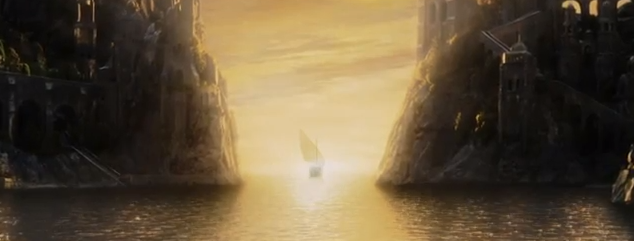
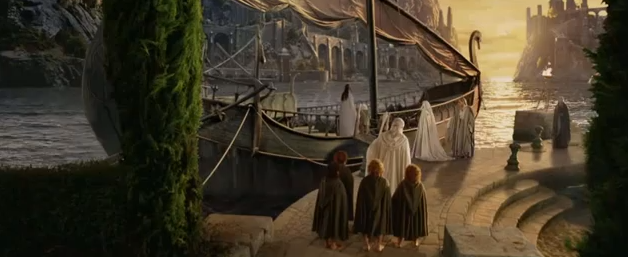
So, we are at the beautiful harbour of The Grey Havens. True to form, Jackson creates an almost heavenly appearance. The sky and the buildings glow with the golden sunlight that is streaming across the harbour, whilst the waters glitter with a golden sparkle. It is such a serene atmosphere in comparison to what we have seen in the film so far with the battlefields and Mordor, even compared to the Shire this place and the sea it paths out to look like paradise. The perfect final resting place for the Elves and for Frodo. 

I have noticed that many complain about the length and number of hugs we see in the first three minutes of this scene, but come on. These four hobbits have been friends since they were children and now they have been on an experience together that was so horrific that it's created an unbreakable bond between them. Even when Merry and Pippin had the chance of returning to the Shire and hope that everything would blow over without their help, they continued to fight for their friends, Frodo & Sam. In the film, Sam is turned away by Frodo but even though he has to climb up all the stairs of Cirith Ungol again, he does it because he knows that Frodo has been tricked and is in very great danger. Now, Merry, Pippin, and Sam find out that the friend they were all trying to help and save is leaving, and they will never see him again. 

As Gandalf says farewell to the hobbits, each one is crying except for Frodo because of course he
knows that he is going away with Gandalf, however he also doesn't cry when he himself is saying goodbye to his friends. They are all in tears; Sam is devastated, but Frodo doesn't cry. When Gandalf says 'It is time Frodo' they all look towards him puzzled. Frodo is mainly looking at Sam, because he knows that Sam is the one who will take this the hardest. Frodo was his responsibility on the quest, and now he is leaving. But Frodo tells him honestly, that although they saved the Shire, it wasn't saved for him. And that alone tells Sam that it has nothing to do with the friendship or that maybe Sam didn't look after Frodo enough on the journey, but that in order to destroy the Ring Frodo had to pay the ultimate sacrifice. He could have either lost his life physically or spiritually. Either way he cannot go back to his old life like they can.


There are no tears from Frodo here, even after he hugs all of them. Could this be because the Ring has taken so much from him that he can no longer cry? Are his emotions spent? Or is there just an acceptance - much like his acceptance of the quest when Gandalf sent him to Bree, and like when he took it upon himself at Rivendell and Amon Hen to do what had to be done. Again here there is an acceptance that that's how things are. 

At 2:30mins in the clip, Frodo turns away from Merry and Pippin to have one final goodbye with Sam. This one last, final, big hug, some have said is over the top but these are best friends. They've been together every day for years, encountered the most horrific dangers, near death experiences... they've been the best of friends imaginable. Sam kept Frodo going, Sam saved Frodo's life on a number of occasions. But there is nothing more that Sam can do for Frodo. The look on Frodo's face is one of inexpressible gratitude, love, and care for his unshakeable friend, Sam. Before it was Sam holding Frodo on the slopes of Mount Doom and hiding from Nazgul on The Dead Marshes. But now it is Frodo holding Sam. It's a beautiful moment and truly touching; Elijah Wood really was remarkable in this scene. He doesn't say a lot but he doesn't need to say anything, it's all said in his face. There is a sort of lost soul behind his eyes... the damage caused from being a Ringbearer. 


Finally Frodo kisses Sam on the forehead; in today's modern world we've kind of lost the recognition of a kiss. It's more associated with lovers or being a romantic/sexual thing. But a kiss years ago was a major sign of love and affection in a non-romantic way too. This is a parting kiss to a best friend which symbolises love, care, and a wish for them to live a happy life.


As Frodo walks away from the other hobbits he has an almost blank look in his eyes. Gandalf who has shown his affection for Frodo since the beginning of the story, holds out his hand to the brave, selfless hobbit, who has been lost for so long, and who still looks a little lost. But when Frodo boards the ship and takes one final look back at his friends, he gives them a smile - full of innocence, happiness, and calm - a genuine Frodo smile which we haven't seen since the first scenes in The Fellowship of the Ring. He is happy now. He is about to find peace and go somewhere where he can move on from the traumas of his past. The other hobbits know this, and they manage to smile back at their friend, through the tears, because they are happy for him. The ship sails into a bright and glorious glow of light, and makes us feel a serenity and calm which we know is where Frodo will be going to spend the last of his days. It's a beautiful scene and essential to help us understand the cost the Ring was to Frodo and the sacrifice he has made. 


Does the film end there? No it doesn't. And many have complained that it should have. I recall hearing a few huffs and puffs in the cinema that there was more to come. It only lasts 1:34mins and again, I believe that is essential to finish the film and the trilogy properly.


Clip 2 (above): Sam returns home after saying goodbye to his Frodo. It is very quiet in the Shire; the grass is green, smoke is piping out of chimneys, birds are tweeting, and there is a wonderful silence and contentment of life oozing from the screen, He is greeted by his daughter first, then by his wife Rosie carrying their baby. She kisses her husband. Sam looks up, surrounded by his family, and says,
'Well, I'm back.'
This is a direct quote from the book. Although Sam got married and had children, he couldn't really move on from the past without Frodo being gone either. With Frodo there he still felt responsible for him and still wanted to help him because he could see that his friend was still in pain and living with the trauma. But now Frodo has left and found peace elsewhere, and Sam can finally move on with his new family. He laughs with his daughter and they all make their way into their hobbit home.


As Sam closes the door behind his family, the camera zooms in on the door; the round door with a golden door-knob in the centre. Whether you've read the books or not, the hobbit door is a symbol of the Shire and of hobbits in general. It is so distinct in it's shape and a symbol of wholesomeness, the home, peace outside the wild world of kings, battles, and rings. The track played over this is 'Elanor' in tribute to Sam's daughter Elanor, who was named after the sun-star flower that can only be found in Lothlorien. The track uses the same instruments and a similar structure to the hobbit theme of 'Concerning Hobbits.' So the music creates the feeling of hobbits, as they were, unharmed, but also a new generation and a new life of hobbits because it is a rendition or an extension of the original theme.

So, why does Jackson end the film this way? Although it may not seem cinematic in terms of explosions and victorious battles or special effects, it is cinematic in it's emotions. We see Sam finally moving on with a new life and we finish on a shot of the hobbit door.


What did Frodo and his friends set out to do? Not to save the world or the people of Middle-Earth as such. But the Shire. Whenever Frodo stumbled and fell and could no longer go on, Sam would remind him of the Shire and that would perk Frodo up. That's what they wanted to save because the Shire was untouched by the dangers and greed of the world of men. So much so that Sam and Frodo shouldn't have been anywhere near Mordor, 'By rights we shouldn't even be here.' The Shire is so unconnected and uncorrupted by the outside world that hobbits are more resilient to the power of the Ring than men are. The Ring and Sauron had never intended for it to end up in the hands of hobbits, nor did they perhaps even know what hobbits were.

For me that is why Jackson ended it with that scene in the Shire. He kept the original words of the book to show the emotional step Sam was now able to take. He shows that new life is now able to go on because the Ring was destroyed. Additionally, everything pure and good which is embodied in the Shire has been saved. Therefore a shot of the door, that unique and memorable shape, is used. Because the family home/new life has been saved but also the beautiful Shire. I think also that the closing of a door is a nice way to close the trilogy - all is finished. This story has come to it's end.

I find the ending really emotional and know that many agree. It encapsulates the emotions and themes of friendship, family, and all of those universal themes/truths that Tolkien spoke so truly. I think Jackson did a brilliant job there and I truly believe that it couldn't have ended better. An epic story needs a proper ending, not something slap dash which leaves questions unanswered and other endings untold. Well done Peter Jackson and your team - you did better than any of us could.

Tuesday, 14 May 2013

Shore's Score: Analysis of 'The Black Gate Opens.'

Using my first blogpost to analyse one of the pieces that is used towards the finale of The Lord of the Rings: The Return of the King may seem like a stupid idea, however, it's the piece that I have the most to say about at the moment.

Yes, my first blogpost will be looking at 'The Black Gate Opens' composed by Howard Shore and featuring the flute virtuoso, Sir James Galway. Here is the music on YouTube >>>  in case you want your memory refreshed or don't have the soundtrack. I will be looking at the section from 1:00-1:40. However if you would prefer to listen to the music in the scene itself you will find that scene later in my blogpost via a YouTube link.

This music comes at the final hurdle of the story. After battles in Rohan and Gondor, meetings with Ents, and all manner of non-stop fighting, Aragorn, Gandalf, Legolas, Gimli, Merry, and Pippin can do no more except one thing - draw out Mordor's armies so that Frodo & Sam can pass through the land unseen, whilst simultaneously diverting Sauron's attention from the Ring; as Legolas calls it... 'a diversion.'

We must remember that Aragorn & co. have no idea how Frodo & Sam are doing. They know that the journey of the Ringbearer and his friend has been the most dangerous (particularly when they hear how both took the path of Cirith Ungol and are being led by Gollum), but they still hold out on a very small hope that their friends are are as well as can be and are close to finishing the quest. Throughout the trilogy, a lot of the action has involved Aragorn and everyone else - they have fought all of the battles. But at this point in front of the Black Gate, even though they have one more battle to fight, they know that there will be no victory in this battle. They are merely buying precious time for their two friends. The REAL battle is taking place between Frodo and the Ring - between two hobbits and Mount Doom. After the initial menacing sounds of Mordor and battle - 'The Black Gate Opens' - that we hear as Aragorn and co. stare at the endless outpourings of hideous orcs, the camera cuts to Frodo & Sam as they try desperately to climb up the mountain.

The music for this scene starts at 1minute on the soundtrack, but in the actual scene itself (see clip below) it starts at 1:51. I will from now on be referring to the times on the clip below.


As Frodo looks up with his tired eyes the camera cuts to a shot of Mount Doom, spurting fire and smoke and dominating all of the Ringbearer's sight with its enormous size... they still have a long way to go. Whilst we see this a familiar sounding flute begins to play. Melancholy, slow, going from low to high notes as we cut from small hobbit to huge mountain, the music mirrors Frodo's feelings of 'so near and yet so far'. That familiar sound of the flute then begins to play the theme of the Shire, or 'Concerning Hobbits' from The Fellowship of the Ring soundtrack. But this isn't the same merry, happy, joyful theme that we heard in the first film as Gandalf and Frodo rode to Bag-End. Far from it. As the trilogy progresses we actually hear snippets from the Shire theme every now and then, but what is interesting is that as Frodo & Sam get closer to Mordor, the theme gets slower and sadder - very clever and effective Howard Shore!

The camera cuts to Frodo's dirtied, haggard feet that have travelled non-stop for the past year - and not across soft, lush grassland, but the sharp rocks of the Emyn Muil, the bogland of the Dead Marshes, the black razor rocks of Minas Morgul, and the hot, ashy wasteland of Mordor. Now, his poor feet - and hands too - have to wearily claw their way up the impossible terrain of the mountainside.

If you listen to the music during this scene from 2:02-2:30 (actual scene), Shore has used the Shire theme at its saddest. Completely slowed down, and sounding strained/shaky, it is at its most desperate - just like Frodo and Sam. Compared to how it was before the quest for Middle-Earth, it is also has a harder and forced sound rather than the light and bouncy feel which it had previously.

Why has Shore/Jackson decided to have this music in this scene? The obvious answer is that the camera is on Frodo and he is a hobbit, therefore they have the theme of the Shire. But I think that there is much more to it than it simply being the theme of the hobbits and the Shire.

First of all I think the music reminds the audience that these are hobbits - two tiny people; one of them has an enormous burden around his neck, whilst the pair of them still have an enormous quest (in terms of mountain-size and doom of failure) ahead of them. The shots of Frodo's feet on the sharp, hard, dry rocks, his mouth panting and his lips cracked and dry - you see the hardship he has endured and just how difficult his quest has been. In the back ground we see Sam lying down for a rest, one of the few times where Sam isn't seen to be pushing Frodo along... even Sam is struggling at the last hurdle. They are very close to the finish line and yet this will still be the toughest part of their long journey.

Frodo has no physical energy left. The length of his travels plus the lack of food/water means that there is no where for him to get his strength from. So, what pushes Frodo to keep climbing that mountain? The fate of Middle Earth? The fate of his friends? Sam? No. I don't think it's any of these. I think what Frodo uses is his distant but very potent memory of the Shire. That's where he gets his strength from. The memory of that peaceful land far away which is untouched by the evils of the world, a land where he was happy and didn't want to leave, his home. And even though the memory is distant - to the point where Frodo later says that he cannot recall the touch of grass - it is still as strong as ever, so he strains to remember it and transform that memory into a formidable strength that pushes him towards the Crack of Doom - hence the straining of the music.

Every strained, shaky, but strong and potent note that comes from Sir James Galway's flute mirrors the unimaginable effort it takes for Frodo to heave himself just a couple of paces up those barren slopes. As we hear this wonderful sound of the Shire and we see little Frodo trying with all his might, we are reminded of the enormity of the task that he was appointed with. From 2:10-2:20 in that scene, the music gets stronger and stronger, and even though Frodo eventually collapses in need of rest, the music mirrors the fact that no matter how long it takes, no matter how little strength Frodo has in him, he is still endeavouring to complete his task.

Apologies for my lack of musical jargon. I've never analysed music before. But I hope that you enjoyed this analysis. It's one of my favourite pieces from the entire trilogy because of how transformed the sound of the Shire is and how brilliantly it mirrors the emotions of Frodo and the quest in general. It brings tears to my eyes. Shore did a magical job with this scene, in my opinion.

If you have any other thoughts on this piece or this scene, I would love to know. Please share in the comments section.

Sunday, 5 May 2013

Shore's Score: A Series

Howard Shore
One of the main reasons why I started this blog was so that I could share my thoughts on the The Lord of the Rings Trilogy which was composed by Howard Shore. Shore really transcended the realms of scoring a film when he composed this soundtrack for Peter Jackson - the size and scope of his work is enormous, complex, and beautiful. Arguably the greatest soundtrack in film history, I shall discuss each piece from Shore's work and analyse it in detail. There won't be any classical jargon - I'm afraid understanding the technical side of classical/film music is something I do not possess. However I will try and unpack the key themes/moods of each piece individually to see just how the music reflects the emotions/elements of scenes/themes in the film.

This series will be called Shore's Score. The first post of this series will be written as soon as possible.

About this blog.

Hi! I'm Claudia, and welcome to my blog.

As you can probably guess from the title, this blog is concerned with the The Lord of the Rings. I've been a fan of the film trilogy since it was released in theatres and after only recently reading Tolkien's books (including The Hobbit) I find that I love the story of Middle-Earth even more than before. 

I adore the books, the films, the soundtrack of the films - there are so many aspects of LOTR which I love and have thoughts on that I thought it may be worth blogging about it in case somebody else was also interested and wanted discuss certain ideas further. I have already written a few LOTR posts on my other blog but seeing as that blog is dedicated to film in general, I didn't want to clog it up with purely LOTR posts. That's when I thought I should launch a LOTR blog.

I haven't started writing any posts yet but I will soon. I am not a Tolkien or Middle-Earth expert - not by far - so please forgive me for not quite knowing the full picture that is painted in The Silmarillion. However I really love Tolkien's works of The Hobbit and The Lord of the Rings, I love Peter Jackson's adaptation, and so many other things in the films and books. I hope that my enthusiasm for LOTR will mean that other fans who read this blog will agree with what I write and most importantly, enjoy it. 

That's my introduction to the blog! Feel free to comment and even disagree with my ideas, I'll enjoy the discussion. Thanks for stopping by and I hope that at least one thing I say will interest you.