Showing posts with label gandalf. Show all posts

Saturday, 15 June 2013

The Desolation of Smaug - 1stTrailer: My Thoughts

BEWARE! SPOILERS (if you haven't seen the first film or read the book)


The much-anticipated first trailer to Peter Jackson's upcoming film, The Hobbit: The Desolation of Smaug has finally been released. After the first installment of The Hobbit franchise received a mixed reception (yet still managed to rake in the money - $1.17 billion worldwide according to boxofficemojo.com) it would appear that expectation for the second installment is even greater than it was for the first. By the looks of people's reactions across the internet, most were interested to see if we got a peak at Smaug, or Orlando Bloom reprising his role as our favourite elf, Legolas. We got both of those things as well as a host of others. This trailer is a very good one. It shows a lot considering how early it has been released and really has that 'I have to see this now!' factor. Here I'll just share my thoughts on 8 things that intrigued me most when viewing the first trailer. If you haven't seen the trailer already then you'll find it below:


Our first shot is of The Lonely Mountain (I'm guessing) which reminds the audience of the destination of the quest. But just as we are shown this intimidating landscape, we hear an authoritative, wise, and regal voice who states the basic premise of the quest, 'to reclaim a homeland and slay a dragon.'


We are shown glimpes of other locations as the voice goes on, including the Woodland realm (above) - which looks very much similar to the design of Lothlorien and with bits of Rivendell in The Fellowship of the Ring, but with more green and brown tones, and a more twisted/wild look (suiting Mirkwood) which makes it noticeably different yet undoubtedly belonging to the race of Elves (elegant, magical). 

1.) Thranduil. 


As the voice comes to the end of his statement we are shown a shot of Thranduil, King of the Woodland Realm played by Lee Pace. Being Legolas's father, it is obvious that the make-up department have tried to make him look similar to his onscreen son, with very light blonde hair and dark brows. He has a fantastic crown that resembles elegant yet dangerously spikey branches, hinting that although the Elven race is graceful and beautiful, it can also be deadly. I have never seen Lee Pace in his screen work but just from the few seconds of this clip I can see he will do a superb job as Thranduil. His voice has a deep, commanding, superior, and almost languid quality to it, making him seem wise and as old as he is. It would appear that Pace has really studied his character in the book whilst ensuring that he appears equal in importance and royalty to Galadriel, Celeborn, and Elrond form the LOTR films. Cate Blanchett, Marton Csokas, and Hugo Weaving in the LOTR trilogy all gave their characters a gravitas, magic, mystery, and all-knowing quality, which made them seem like real Elves (Celeborn in the Extended Edition of LOTR - wish they hadn't cut his scene with Aragorn). Pace has a lot to live up to after Blanchett, Csokas, and Weaving did such a tremendous job, but it seems like Pace will fit in well with Elven royalty in Peter Jackson's Middle Earth already, and is every inch the King of the Woodland Realm.

2.) Legolas.


As soon as it was announced that Orlando Bloom would be returning as Legolas, the majority of us had our anticipation levels reach stratospheric heights. Yes, Legolas is not in the original book but seeing as his father Thranduil is then I don't really see the harm in including him at all. It gives a sense of continuity with the LOTR trilogy, and as long as there isn't a massive change to the story by including his character then I see no problem whatsoever. My first thoughts when seeing Legolas was that he looks older, much like I thought in the previous Hobbit film when I saw Gandalf, Galadriel, Frodo, Saruman, Bilbo (old), and Elrond. Yes I know it's obvious that they would all have aged because they're human too, LOTR was filmed over a decade ago, etc, but seeing Legolas was a sad reminder that it was over 10 years ago that we first saw those films. I was a kid at the end of primary school when FOTR came out, and now I've graduated from university. Was it really that long ago that we first saw Jackson's interpretation of Tolkien's Middle Earth? Nevertheless he still looks beautiful and he is still our Legolas; it was really wonderful to see him back with his bow and arrow. The line, 'Don't think I will not kill you dwarf,' is brilliant, and harks back to the friendship Legolas has with Gimli in LOTR, a friendship that began as hostile enemies, yet ending with one of the truest and most beautiful friendships in literature. I wonder if we'll see Legolas perform death-defying stunts like he did in LOTR. Fingers crossed! Go Bloom!

3.) Beorn?


This is a very short glimpse of a bear but I'm guessing it's Beorn. Because the clip is so short there is very little to say, however, I am curious as to how Jackson and his team will make Beorn convincing as a "shape-shifter" and if his form as a bear is realistic. They did an excellent job with Treebeard who was a talking tree/Ent, so I doubt that we'll be disappointed with Beorn.

4.) Tauriel.


Arguably the most controversial move Peter Jackson and his team have made in The Hobbit trilogy is the creation of an entirely new character that isn't in the books. I can understand why Jackson wanted a female character in the Hobbit films because it appeals to a wider audience (females); LOTR didn't have that problem because you had 4 female characters; Rosie Cotton, Arwen, Galadriel, Eowyn (the latter 3 being very important to the narrative and strong, female roles). But to create one is risky and has upset many fans. I have never seen Lost so I don't really know what Evangeline Lily is like as an actress, but in the trailer she seems fine, she seems like a proper elf, and I hope that she proves Jackson's move to be a good one. I won't be happy if they make her this tough, kick-ass, rebel elf that has a romance with Legolas - that will be ridiculous, annoying, and totally unnecessary. By the looks of the trailer though she'll be a good addition and not cause major changes to the narrative. Good luck, Evangeline Lily!

5.) Dol Guldur.


Gosh, how ominous and foreboding does Dol Guldur look? It looks so creepy and otherworldly... the ultimate lair for the Necromancer. This one is going to be risky too, as what takes place at Dol Guldur is not shown or told in the book as such, it is only hinted at, but we are told in LOTR what happened there (possibly a brief explanation at the end of Hobbit but I can't remember). Regardless, Gandalf is there with his sword, staff, and Radagast, and utters, 'It is undoubtedly a trap.' OMG. There's going to be some serious s**t going down at Dol Guldur and I cannot wait. 

6.) The Mirkwood Spiders.


When I saw the first Hobbit film in January my heart dropped when Radagast was inside his house and you could see the shadows of hundreds of spiders crawling up the outside of his windows. I hadn't read the book at the time, but being an arachnophobe, I immediately thought, oh no - not more Shelobs. The spiders of Mirkwood were terrifying in the book, especially with their metallic-y, hissing, speech. Somewhere online I read that they were descendants of Shelob but she is in a monster league of her own, evil in spider form- these spiders are slightly different and definitely smaller (fewf!). I have heard Jackson say that his team had to make these spiders different and distinct from Shelob herself. However, by the looks of the spider visible in this trailer, the spiders (thankfully) won't be as scary or monstrous as Shelob in The Return of the King. The spider you see in the above screenshot has skinny legs (they haven't shown it's body or face so I am still terrified of what they may look like) but at the moment the spider scene looks like it will be watchable for arachnophobes like myself. I want to be scared of the spiders in this film because of their evil nature not because of their appearance (the more I watch The Return of the King, the less of the Shelob scene I can watch.) For now, all looks positive. I do wonder if Jackson will let these spiders speak like they do in the book? Animals speaking can often look silly, so it will be interesting to see if they avoid this trait of theirs or what they do to make it convincing.

7.) Arrival at The Lonely Mountain.


'That my friend... was a dragon,' says Balin as the dwarves supposedly here a rumble from within the mountain. This promises us that there will be some dragon action in the second installment. I expect that half of the film will be set in Mirkwood whilst the rest will take place at the Laketown and the mountain. A great line for the trailer, it wets our appetite for what is to come. It also hints that the other, younger dwarves haven't really thought about what they've let themselves in for.

8.) Smaug.


Unbelievable, the trailer finishes with a sneak peak of Smaug himself. SHOCK! We only saw his eye in the first film, but here we see his shadowed face. Unfortunately, after reading comments online it looks like people thought the same as myself - he looks a little raptor-y? And a definite shift away from the look of dragons in classic children's literature. Jackson may have done this purposefully however, because he knows that with any clip he releases, he will be inundated with comments and criticisms. In Fellowship of the Ring we see Gollum twice but each time he is covered in shadow; this is because final touches were still being made to Gollum and his appearance really hadn't been finalised yet. That way, Gollum was still visible in the film but you couldn't quite make out the exact features of his face. I think Jackson may be doing the same here with Smaug. Testing what the audience thinks whilst his artists still work on getting the right look for Smaug. The shot of Smaug's eye at the end of the first Hobbit film was promising, so let's hope Jackson stills pulls it out of the bag. 

I do not envy Jackson and his team with creating Smaug though. From how the dwarves described the attack on Erebor, dragons sound like the worst creatures in Middle Earth - meaner, lethal, and more dangerous than Shelob, Nazgul and their beasts, or Balrogs - and dragons are ten times bigger! So Jackson and co. really have their work cut out for them to make Smaug the dragon seem as terrible as legend has it. They haven't let us down with creatures so far, I'm sure they won't this time either. 

Final thoughts?

Overall, The Hobbit: The Desolation of Smaug looks promising, more action-packed, and full of thrills than it's previous installment. You can see some of the changes from the book in the trailer and it looks like most of them will be to make the story more suitable for cinema - not all scenes in books work on film. Fingers crossed that this time the pace and editing of the film will be more flowing and the story in general more planned out. The first Hobbit film seemed incredibly rushed and had a lot wrong with it - still enjoyed it though! I don't think I will ever grow to like the villain of Azog in the film, he really irritates me and annoyingly looks like a highly-computerised, thuggish Voldermort. From what the trailer shows it's going to be a fun-filled ride and a big improvement from the first film. Can't wait to see what Benedict Cumberbatch brings to his roles too, and of course, we know that Martin Freeman will be outstanding again. It's a shame we have to wait until December, ey? It will be worth the wait, I am sure, and makes the perfect early Christmas present. I'm loving this poster for it too (right >). 

Monday, 27 May 2013

Scene Analysis: The Return of the King - The Final Scene.

One of the most common debates concerning The Lord of the Rings Trilogy is whether Peter Jackson ended it well. Many have said that the trilogy should have ended with Aragorn's coronation at Minas Tirith, others say it should have ended when Frodo left for The Grey Havens, and some say that it should have ended even earlier with the destruction of the Ring and the collapse of Mordor. It is a difficult question, firstly because you can never please everyone, and secondly, Jackson had the difficult task throughout the books of deciding what was cinematic and what wasn't. What works in books doesn't always translate well on film, and Jackson made a lot of changes in the story to increase the cinematic effect of the films - which I believe is completely justified because any changes made never altered or ruined the overall theme of Tolkien's work.

However, when it comes to how to end this enormous and epic trilogy, do you need a big climactic finale to give it that ultimate punch? Or do you try and stay as true to the book as possible and go for a more emotional ending that causes the film to run a little longer and therefore annoy some of the audience. I finally read JRR Tolkien's books this year and have seen that Jackson cut a lot of the ending out already, e.g. The Scouring of the Shire. I understand his choice for this, the film would have been too long and it wasn't quite essential for the films themselves. In the book it works because when they defeat 'Sharky' Saruman and rebuild the Shire they plant mellyrn trees that Galadriel gifted them from Lothlorien... basically a lot of events that happened earlier in the books are tied up at the end. If they weren't included in the film to start with then there's nothing to really tie-up at the end.

Since the films release over a decade ago I was unsure of whether The Return of the King had dragged on a little too long and whether Jackson had perhaps indulged himself. But after finally reading Tolkien's trilogy and watching the films for the, I don't know, 50th (?) time, I believe that it ended perfectly with Sam returning to his new family and finally moving on. I will be discussing the ending and dissecting it's shots, dialogue, and themes to justify my opinion. You will find the clips for the two scenes that I will be analysing to the side here and later in the blogpost. Clip 1 is The Grey Havens Scene and Clip 2 is The End scene; any times I mention will be from these clips.


Let's start with the scene at The Grey Havens. In the films we have just seen Frodo finishing his book whilst he tells us that he can't live in the Shire anymore, his quest as the Ringbearer has made it impossible for him to continue life in his home at Bag End,
'How do you pick up the threads of an old life? How do you go on... when in your heart you begin to understand... there is no going back? There are some things that time cannot mend... some hurts that go too deep... that have taken hold.'
Here he is referring to the wound he received from the Witch-King at Weathertop wound which still causes him physical pain but also the memories and trauma of his journey to Mordor and his burden of the Ring are what gives him the greatest pain, they are what goes too deep. His wounds are both physical and psychological. He is traumatised for life. When you've endured what Frodo did, how on earth could you return to your old life and carry on as normal? The memories would never go away, and if they did for a fleeting moment, the pain from an old wound would be there instead. It irks back to what Galadriel says in  The Two Towers (film), 'The quest will claim his life.' And it has. Frodo may have survived but as far as his life in the Shire is concerned, he's lost it. He cannot go back, there is no place for him there anymore. And he has to leave with the Elves, Gandalf, and Bilbo for him to have any chance of peace and tranquility - for any chance to move on from the trauma he experienced.


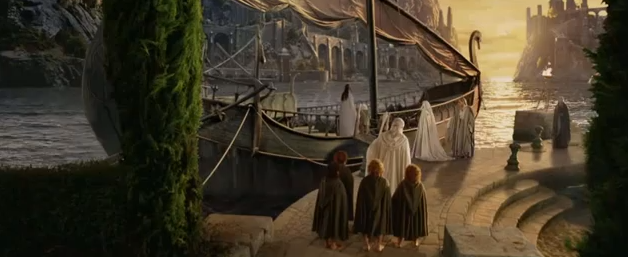
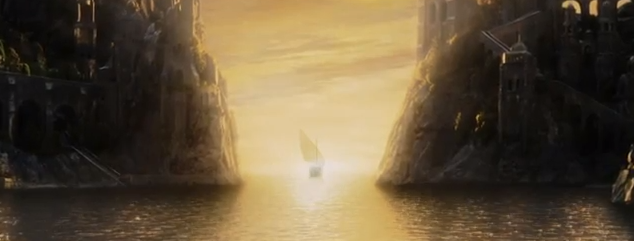
So, we are at the beautiful harbour of The Grey Havens. True to form, Jackson creates an almost heavenly appearance. The sky and the buildings glow with the golden sunlight that is streaming across the harbour, whilst the waters glitter with a golden sparkle. It is such a serene atmosphere in comparison to what we have seen in the film so far with the battlefields and Mordor, even compared to the Shire this place and the sea it paths out to look like paradise. The perfect final resting place for the Elves and for Frodo. 

I have noticed that many complain about the length and number of hugs we see in the first three minutes of this scene, but come on. These four hobbits have been friends since they were children and now they have been on an experience together that was so horrific that it's created an unbreakable bond between them. Even when Merry and Pippin had the chance of returning to the Shire and hope that everything would blow over without their help, they continued to fight for their friends, Frodo & Sam. In the film, Sam is turned away by Frodo but even though he has to climb up all the stairs of Cirith Ungol again, he does it because he knows that Frodo has been tricked and is in very great danger. Now, Merry, Pippin, and Sam find out that the friend they were all trying to help and save is leaving, and they will never see him again. 

As Gandalf says farewell to the hobbits, each one is crying except for Frodo because of course he
knows that he is going away with Gandalf, however he also doesn't cry when he himself is saying goodbye to his friends. They are all in tears; Sam is devastated, but Frodo doesn't cry. When Gandalf says 'It is time Frodo' they all look towards him puzzled. Frodo is mainly looking at Sam, because he knows that Sam is the one who will take this the hardest. Frodo was his responsibility on the quest, and now he is leaving. But Frodo tells him honestly, that although they saved the Shire, it wasn't saved for him. And that alone tells Sam that it has nothing to do with the friendship or that maybe Sam didn't look after Frodo enough on the journey, but that in order to destroy the Ring Frodo had to pay the ultimate sacrifice. He could have either lost his life physically or spiritually. Either way he cannot go back to his old life like they can.


There are no tears from Frodo here, even after he hugs all of them. Could this be because the Ring has taken so much from him that he can no longer cry? Are his emotions spent? Or is there just an acceptance - much like his acceptance of the quest when Gandalf sent him to Bree, and like when he took it upon himself at Rivendell and Amon Hen to do what had to be done. Again here there is an acceptance that that's how things are. 

At 2:30mins in the clip, Frodo turns away from Merry and Pippin to have one final goodbye with Sam. This one last, final, big hug, some have said is over the top but these are best friends. They've been together every day for years, encountered the most horrific dangers, near death experiences... they've been the best of friends imaginable. Sam kept Frodo going, Sam saved Frodo's life on a number of occasions. But there is nothing more that Sam can do for Frodo. The look on Frodo's face is one of inexpressible gratitude, love, and care for his unshakeable friend, Sam. Before it was Sam holding Frodo on the slopes of Mount Doom and hiding from Nazgul on The Dead Marshes. But now it is Frodo holding Sam. It's a beautiful moment and truly touching; Elijah Wood really was remarkable in this scene. He doesn't say a lot but he doesn't need to say anything, it's all said in his face. There is a sort of lost soul behind his eyes... the damage caused from being a Ringbearer. 


Finally Frodo kisses Sam on the forehead; in today's modern world we've kind of lost the recognition of a kiss. It's more associated with lovers or being a romantic/sexual thing. But a kiss years ago was a major sign of love and affection in a non-romantic way too. This is a parting kiss to a best friend which symbolises love, care, and a wish for them to live a happy life.


As Frodo walks away from the other hobbits he has an almost blank look in his eyes. Gandalf who has shown his affection for Frodo since the beginning of the story, holds out his hand to the brave, selfless hobbit, who has been lost for so long, and who still looks a little lost. But when Frodo boards the ship and takes one final look back at his friends, he gives them a smile - full of innocence, happiness, and calm - a genuine Frodo smile which we haven't seen since the first scenes in The Fellowship of the Ring. He is happy now. He is about to find peace and go somewhere where he can move on from the traumas of his past. The other hobbits know this, and they manage to smile back at their friend, through the tears, because they are happy for him. The ship sails into a bright and glorious glow of light, and makes us feel a serenity and calm which we know is where Frodo will be going to spend the last of his days. It's a beautiful scene and essential to help us understand the cost the Ring was to Frodo and the sacrifice he has made. 


Does the film end there? No it doesn't. And many have complained that it should have. I recall hearing a few huffs and puffs in the cinema that there was more to come. It only lasts 1:34mins and again, I believe that is essential to finish the film and the trilogy properly.


Clip 2 (above): Sam returns home after saying goodbye to his Frodo. It is very quiet in the Shire; the grass is green, smoke is piping out of chimneys, birds are tweeting, and there is a wonderful silence and contentment of life oozing from the screen, He is greeted by his daughter first, then by his wife Rosie carrying their baby. She kisses her husband. Sam looks up, surrounded by his family, and says,
'Well, I'm back.'
This is a direct quote from the book. Although Sam got married and had children, he couldn't really move on from the past without Frodo being gone either. With Frodo there he still felt responsible for him and still wanted to help him because he could see that his friend was still in pain and living with the trauma. But now Frodo has left and found peace elsewhere, and Sam can finally move on with his new family. He laughs with his daughter and they all make their way into their hobbit home.


As Sam closes the door behind his family, the camera zooms in on the door; the round door with a golden door-knob in the centre. Whether you've read the books or not, the hobbit door is a symbol of the Shire and of hobbits in general. It is so distinct in it's shape and a symbol of wholesomeness, the home, peace outside the wild world of kings, battles, and rings. The track played over this is 'Elanor' in tribute to Sam's daughter Elanor, who was named after the sun-star flower that can only be found in Lothlorien. The track uses the same instruments and a similar structure to the hobbit theme of 'Concerning Hobbits.' So the music creates the feeling of hobbits, as they were, unharmed, but also a new generation and a new life of hobbits because it is a rendition or an extension of the original theme.

So, why does Jackson end the film this way? Although it may not seem cinematic in terms of explosions and victorious battles or special effects, it is cinematic in it's emotions. We see Sam finally moving on with a new life and we finish on a shot of the hobbit door.


What did Frodo and his friends set out to do? Not to save the world or the people of Middle-Earth as such. But the Shire. Whenever Frodo stumbled and fell and could no longer go on, Sam would remind him of the Shire and that would perk Frodo up. That's what they wanted to save because the Shire was untouched by the dangers and greed of the world of men. So much so that Sam and Frodo shouldn't have been anywhere near Mordor, 'By rights we shouldn't even be here.' The Shire is so unconnected and uncorrupted by the outside world that hobbits are more resilient to the power of the Ring than men are. The Ring and Sauron had never intended for it to end up in the hands of hobbits, nor did they perhaps even know what hobbits were.

For me that is why Jackson ended it with that scene in the Shire. He kept the original words of the book to show the emotional step Sam was now able to take. He shows that new life is now able to go on because the Ring was destroyed. Additionally, everything pure and good which is embodied in the Shire has been saved. Therefore a shot of the door, that unique and memorable shape, is used. Because the family home/new life has been saved but also the beautiful Shire. I think also that the closing of a door is a nice way to close the trilogy - all is finished. This story has come to it's end.

I find the ending really emotional and know that many agree. It encapsulates the emotions and themes of friendship, family, and all of those universal themes/truths that Tolkien spoke so truly. I think Jackson did a brilliant job there and I truly believe that it couldn't have ended better. An epic story needs a proper ending, not something slap dash which leaves questions unanswered and other endings untold. Well done Peter Jackson and your team - you did better than any of us could.